artificial intelligencecybersecuritythreat detectionincident responsesecurity careers
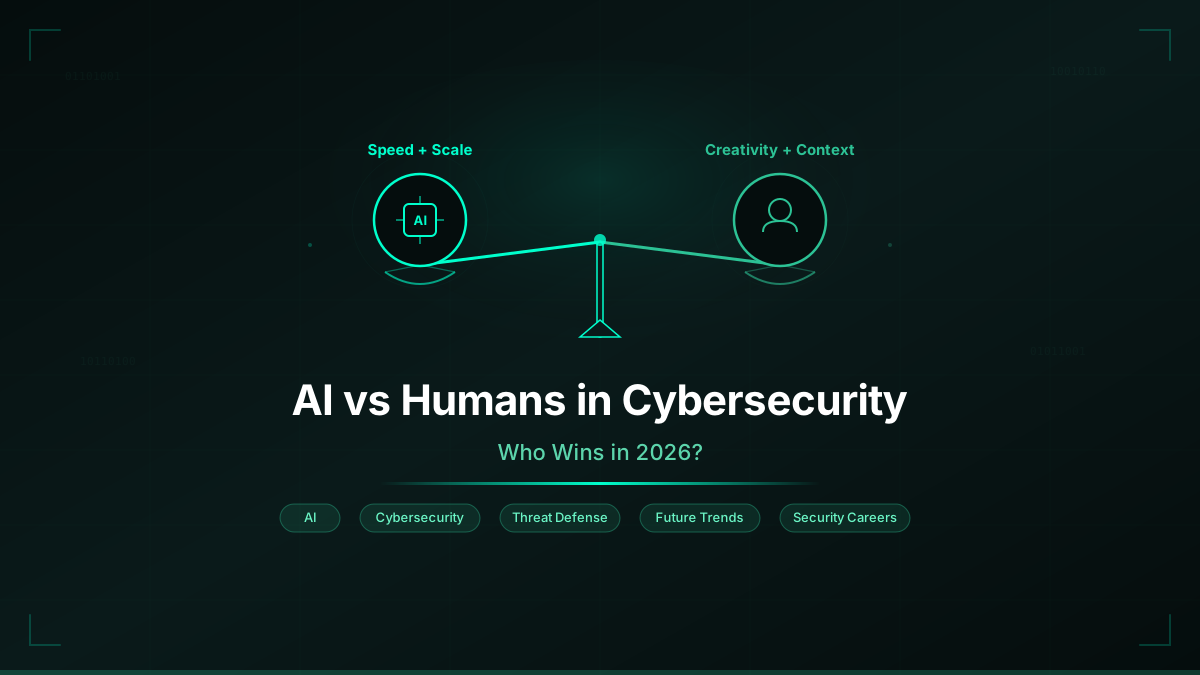
AI vs Humans in Cybersecurity: Who Wins in 2026?
Security Research Team··5 min read
93 Million Records. Zero Humans Consulted.
In mid-2023, the MOVEit breach compromised over 93 million individuals across 2,700+ organizations. Automated scanning found the vulnerability. Automated exploitation deployed the payload. The whole attack chain fired off before most SOC teams had finished their morning standups.
Here's the uncomfortable part: AI-speed attacks now demand AI-speed defense. But the organizations that contained the damage fastest? They weren't the ones with the fanciest AI tools. They were the ones with experienced incident responders who knew exactly which systems to pull offline and which stakeholders to wake up.
So who actually wins? Let's break it down.
Round 1: Threat Detection
AI Advantage: Speed and Scale
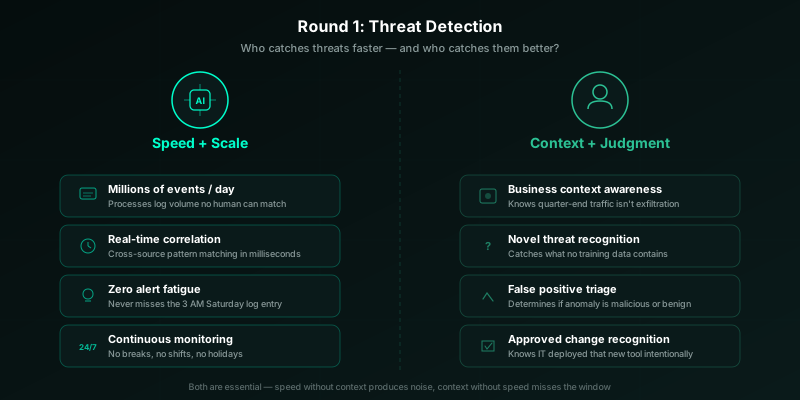
A modern SOC processes millions of events per day. No human team reviews even a fraction of that. AI thrives here correlating events across sources, flagging anomalies in real-time, never burning out at 3 AM on a Saturday.
ML models trained on network traffic can spot C2 communication patterns, lateral movement, and data exfiltration attempts in milliseconds. They don't take breaks. They don't miss the one weird log entry because they're on their fourth coffee.
Human Advantage: Context and Novel Threats
AI models are trained on known patterns. A genuinely novel technique, one that matches nothing in the training data, is invisible to the model. It'll flag the anomaly, sure. But it can't tell you whether that anomaly is malicious, benign, or just Jenkins doing something weird again.
Human analysts know that the unusual finance department traffic during quarter-end is reporting, not exfiltration. They remember that IT deployed that "suspicious" new tool last Tuesday. Context is everything, and context isn't something you train into a model overnight.
Round 1 Verdict: AI wins on volume and speed. Humans win on accuracy and context. Together, they catch more than either alone.
Round 2: Incident Response
AI Advantage: Automated Containment
When a confirmed incident hits, seconds matter. AI-powered SOAR platforms execute containment playbooks instantly: isolating endpoints, blocking IPs, disabling compromised accounts, kicking off forensic collection. For known incident types, AI handles the first 90 seconds faster and more consistently than any human team. Not even close.
Look at the 2024 Change Healthcare ransomware attack. The initial spread happened in minutes, not hours. That kind of window doesn't wait for someone to context-switch out of a Jira ticket.
Human Advantage: Investigation and Judgment
After containment, things get messy. What did the attacker actually access? How'd they get in? Are there other compromised systems we haven't found yet? Should you preserve the machine for forensics or wipe and rebuild right now?
And then there's the hard part: communication. No model decides how to brief leadership on a breach without triggering a panic. No playbook tells you whether to disclose early or wait until you've got the full picture. That's judgment. That's experience. That's human.
Round 2 Verdict: AI wins the first 90 seconds. Humans win the next 90 hours.
Rounds 3 to 5: The Quick-Fire
You get the pattern by now. Here's the rest, same dynamic, different turf:
| Round | Domain | AI Wins | Humans Win |
|---|---|---|---|
| 3 | Vulnerability Research | Known CVE matching and code scanning at scale | Novel discovery: Spectre, Log4Shell, and Heartbleed all came from humans who noticed something felt "off" |
| 4 | Social Engineering | Commodity phishing detection across millions of emails | Targeted spear-phishing that uses real projects, real names, and internal jargon the stuff that sails past filters |
| 5 | Security Strategy | Data-driven risk dashboards and compliance metrics | Explaining to a board why a product launch needs to be delayed. Good luck automating that conversation. |
The Verdict
Let's drop the adversarial framing. The question was never "who wins." It's: where does each one create the most value?
AI should lead: log analysis, real-time detection, automated containment, vulnerability scanning, compliance reporting.
Humans should lead: novel research, incident investigation, security strategy, social engineering training, ethical judgment.
We've watched teams try to go all-in on one side. The "automate everything" crowd drowns in false positives with nobody to triage them. The "AI is overhyped" crowd gets buried in alert volume they can't process. The organizations actually winning in 2026 are the ones that figured out the handoff where AI stops and human judgment picks up.
- Automate detection, investigate with humans. Let AI surface the signals. Let your team determine what they mean.
- AI drafts, humans decide. Risk assessments, incident reports, remediation plans. AI writes the first version, a human makes the call.
- Train your team on AI tools. The professionals who understand what AI can and can't do make better decisions than the ones who either blindly trust it or refuse to touch it.
- Measure what actually matters. MTTD, MTTR, false positive rates. Track whether AI integration is improving outcomes or just adding another dashboard nobody checks.
The Bottom Line
AI versus humans is the wrong framing. The right one is AI × humans, a multiplier, not a competition.
The real question for 2026 isn't "who wins?" It's "how fast can your organization figure out the right integration?"
Because the attackers already have.
If you want to see how AI and human judgment work together in practice, our labs simulate both sides of the equation.
End of Article
Continue Reading
 10 min read
incident responsecyber attack+3
What Happens in the First 60 Seconds After You Get Hacked
A second-by-second breakdown of what actually happens when an attacker gets into your system, and why most teams don't notice until it's far too late.
Security Research Team·2026-03-04
 8 min read
artificial intelligencepenetration testing+3
Can AI Replace Penetration Testers? A Reality Check
Separating hype from reality. What AI can and cannot do in penetration testing, and why the human pentester is not going anywhere.
Security Research Team·2026-03-03
 9 min read
artificial intelligenceexploit development+3
How to Use AI to Write Exploit POCs Faster (The Ethical Way)
A practical guide to using large language models for proof-of-concept development during authorized security engagements. Faster iteration, safer process, better results.
Security Research Team·2026-02-17