artificial intelligencepenetration testingcybersecurity careersautomationethical hacking
Can AI Replace Penetration Testers? A Reality Check
Security Research Team··8 min read
We Keep Getting Asked This Question
Every pentester on our team has heard it at least twice this year. From clients. From managers. From that person at the conference who just found out ChatGPT can write Python.
Can AI replace pentesters?
Short answer: No.
Longer answer: it depends on what you think a pentester actually does. And that's where most of the confusion starts. People who ask this question usually picture penetration testing as "run a scanner, get a report." If that's the job, then yes, AI can do it. But that was never the job.
Let's walk through this honestly. No hype. No defensive panic.
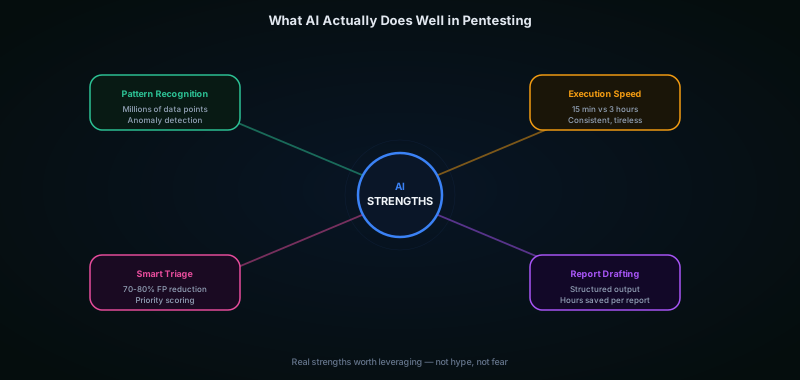
What AI Actually Does Well
Fair is fair. AI has made real improvements in certain parts of security testing. Pretending otherwise would be dishonest.
Pattern Recognition at Scale
AI is great at chewing through massive amounts of data and spotting patterns humans would miss or take forever to find. Vulnerability scanners backed by AI can process thousands of findings and highlight the ones most likely to be exploitable. That's genuinely helpful.
Speed on Repetitive Work
Subdomain enumeration. Port scanning. Technology fingerprinting. SSL certificate analysis. These tasks have clear inputs, clear outputs, and well-defined steps. AI handles them faster and more consistently than any human can. Something that takes a junior tester three hours gets done in fifteen minutes.
Report Drafts
Writing pentest reports is tedious. Most of it follows a predictable structure. AI-generated first drafts are good enough that experienced testers can polish them into final deliverables in a fraction of the usual time.
Where It Falls Apart
Here's where the reality check kicks in. The things AI cannot do are exactly the things that make penetration testing worth paying for.
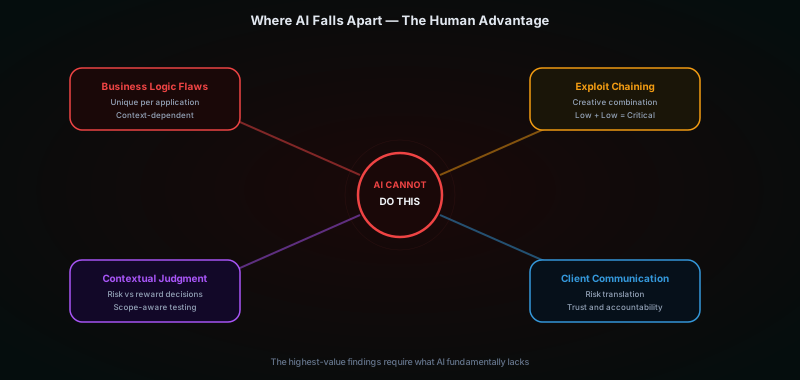
Business Logic Flaws
This is the biggest gap, and it's not closing anytime soon.
Business logic bugs require understanding what an application is supposed to do, then figuring out how to make it do something it shouldn't. A coupon code that works fifteen times. A checkout flow where you can skip the payment step. A role system that blocks self-promotion to admin but lets you create a new admin account through the registration API.
No AI model finds these. They require understanding context, intent, and design assumptions that live in the heads of the developers who built the system, not in the codebase itself. You can't train a model on business logic flaws because every application's logic is different.
Chained Exploits
Real compromise almost never comes from one vulnerability. It comes from stringing three or four low-severity findings into a high-impact attack path. A reflected XSS that steals a session token, combined with an IDOR that accesses another user's data, escalated through a privilege flaw in an admin panel that was supposed to be locked down.
Each finding on its own might rate as medium or low. The chain is critical. AI has no framework for this kind of creative, adversarial thinking.
Judgment Calls
During an engagement, a pentester makes dozens of decisions that have nothing to do with technical skill. Is this finding worth chasing deeper, or is it a dead end? Would this exploit crash production, and is that acceptable within scope? Is the client's environment stable enough to handle this test safely?
These calls require experience, gut feeling, and an understanding of risk that goes beyond severity scores. AI optimizes for whatever metric you hand it. Pentesters optimize for outcomes.
The Automation Misconception
There's a common misunderstanding that penetration testing is mostly technical scanning, and therefore automatable. That misunderstands what a pentest actually is.
A vulnerability scan runs automated checks against known vulnerability signatures. It's a commodity service. Many organizations run scans weekly or even continuously.
A penetration test is an adversarial simulation. It answers the question: What could a motivated, skilled attacker actually achieve against this specific environment? The answer requires creativity, adaptability, and judgment that changes with every target.
Mixing up the two is like saying a spell checker can replace an editor. Both deal with text. That's where the similarity ends.
What Clients Actually Pay For
When a company hires a penetration testing team, they're not paying for a scan. They're paying for:
- Adversarial creativity. Attack paths a scanner would never consider.
- Contextual risk assessment. Findings prioritized by business impact, not just CVSS score.
- Narrative reporting. Explaining not just what is broken, but why it matters and what to do about it.
- Trust and accountability. A named professional who stands behind their findings.
AI provides none of these. It provides data. The value lives in the interpretation.
What Actually Happens Next
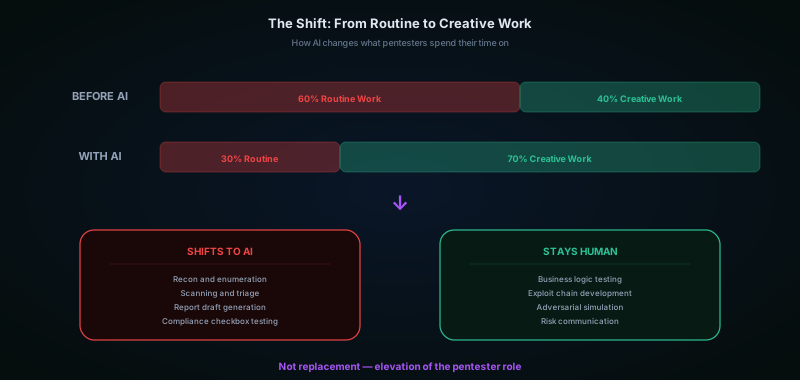
The realistic future isn't AI replacing pentesters. It's AI changing what pentesters spend their time on.
Tasks That Shift to AI
- Reconnaissance and enumeration
- Initial vulnerability scanning and triage
- False positive filtering
- Report draft generation
- Compliance checkbox testing
Tasks That Stay Human
- Business logic testing
- Exploit chain development
- Red team operations and adversarial simulation
- Client communication and risk translation
- Scope management and ethical judgment calls
- Novel vulnerability discovery
The net effect? A pentester's day shifts from 60% routine and 40% creative work to roughly 30% routine and 70% creative work. That's not replacement. That's elevation.
The Career Implications
If you're a pentester thinking about what this means for your career, here's the practical side:
- Learn to use AI tools effectively.
Pentesters who integrate AI into their workflow will outperform those who don't. This isn't optional anymore.
- Go deeper on business logic.
This is the area AI cannot touch. Understanding how applications work at a business level makes you irreplaceable.
- Get good at exploit chaining.
Combining low-severity findings into high-impact attack paths is a distinctly human skill, and it commands premium rates.
- Invest in communication.
Translating technical findings into business risk language gets more valuable as the commodity work gets automated.
- Stay current on AI capabilities.
Know what the tools can and cannot do so you can set accurate expectations with clients and use them intelligently.
The Bottom Line
AI is changing the how of penetration testing without touching the what or the why. The routine work gets faster. The creative work gets more of your attention. The human element, judgment, creativity, accountability, stays essential.
The pentesters who get replaced are the ones who were basically running automated scans and calling it a pentest. That was always a low-value service. AI just made it obvious.
The pentesters who thrive are the ones finding business logic flaws, chaining exploits creatively, and turning risk into language that drives real organizational change. No model does that. No model is close.
Stop worrying about replacement. Start thinking about being the pentester who uses AI better than everyone else in the room.
Know a junior pentester stressing about AI taking their job? Send them this. Then teach them business logic testing.
End of Article
Continue Reading
 9 min read
artificial intelligenceexploit development+3
How to Use AI to Write Exploit POCs Faster (The Ethical Way)
A practical guide to using large language models for proof-of-concept development during authorized security engagements. Faster iteration, safer process, better results.
Security Research Team·2026-02-17
 8 min read
ssrfweb application security+3
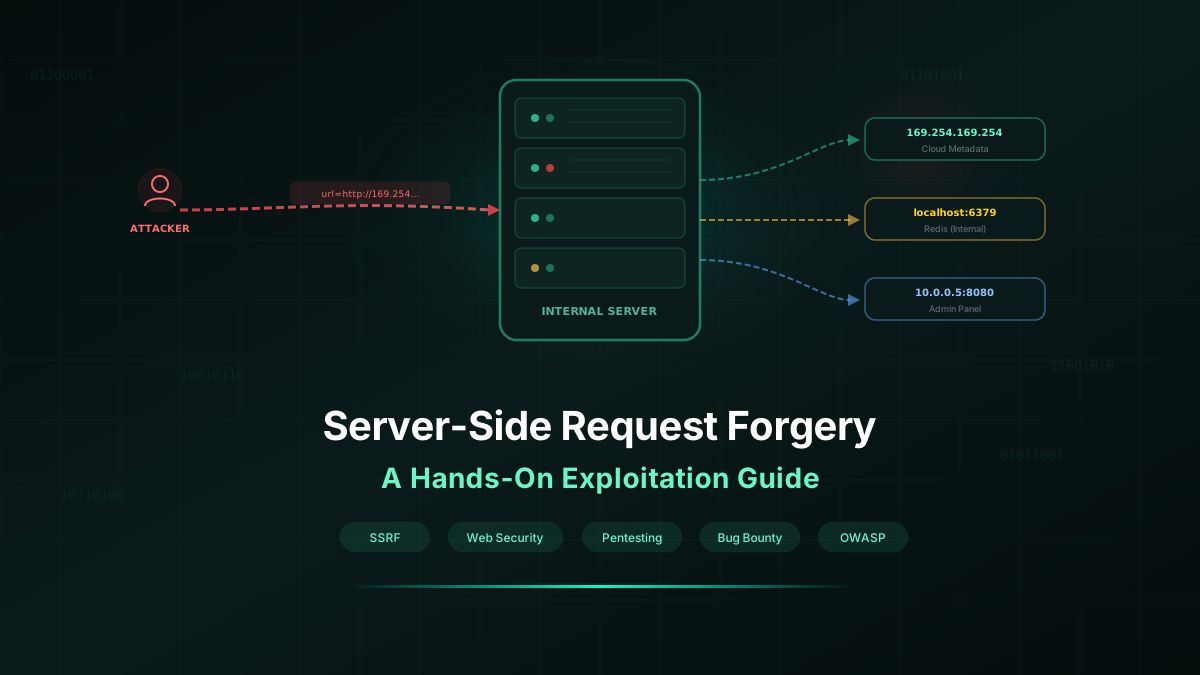
Server-Side Request Forgery (SSRF): A Hands-On Exploitation Guide
A practical, step-by-step walkthrough of SSRF — from finding vulnerable endpoints to exploiting cloud metadata, bypassing filters, and chaining SSRF to full compromise.
Security Research Team·2026-03-07
 8 min read
bug bountyethical hacking training+3
Beginner Guide to Bug Bounty: Find Your First Vulnerability in 7 Days
A realistic 7-day roadmap to finding your first web vulnerability in a bug bounty program, covering tools, methodology, and the mindset that gets results.
Security Research Team·2026-02-16