artificial intelligenceexploit developmentpenetration testingethical hackingproof of concept
How to Use AI to Write Exploit POCs Faster (The Ethical Way)
Security Research Team··9 min read
The PoC Development Bottleneck
Every pentester knows the moment. The vulnerability is confirmed. The mechanism is understood. Exploitability is clear. Now comes the proof.
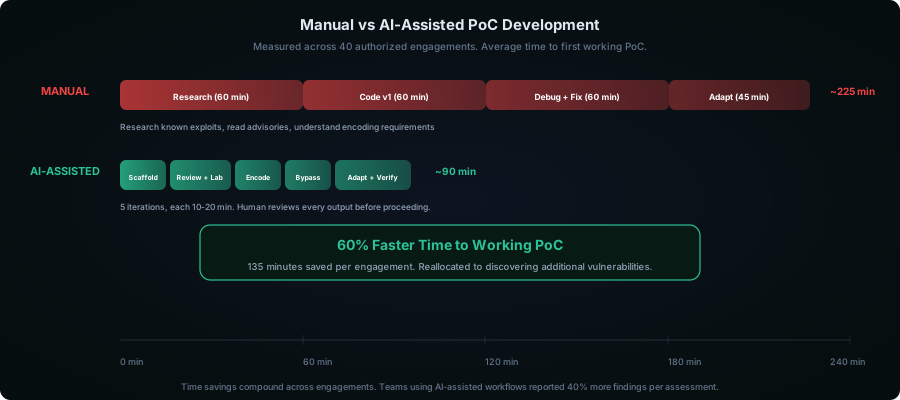
Writing a clean, reliable proof-of-concept takes time. Adapting a public exploit to a specific target environment takes more time. Factor in encoding, WAF bypass logic, error handling, and cleanup routines, and PoC development can consume 25 to 35 percent of total engagement hours. That is time spent writing code instead of finding the next vulnerability.
AI does not eliminate this work. What it does is compress the boilerplate, letting the operator focus on the parts that require genuine expertise: custom logic, environment-specific adaptations, and creative bypass techniques.
The Ethical Framework First
Before any technical discussion, the rules must be non-negotiable. Using AI for exploit development is only acceptable when every condition below is met:
- Written authorization exists. A signed scope document, bug bounty policy, or engagement agreement explicitly permits the testing.
- You are within scope. The PoC targets systems, endpoints, and vulnerability classes that are explicitly in scope. Out-of-scope exploitation is unauthorized regardless of your contract.
- The goal is proof, not damage. A PoC demonstrates exploitability. It does not exfiltrate real data, destroy resources, or cause operational impact. Minimum viable demonstration is the standard.
- You test in a safe environment first. Every AI-generated PoC runs in an isolated lab before it touches the target. No exceptions.
- Findings are reported responsibly. Exploits and PoCs are delivered through secure channels and never published without coordination.
With that foundation established, here is the methodology.
The AI-Assisted PoC Workflow
The effective workflow is not "ask AI to write an exploit." That approach produces unreliable, generic code that rarely works against real targets. The process that delivers results is structured, iterative, and keeps the human in control at every stage.
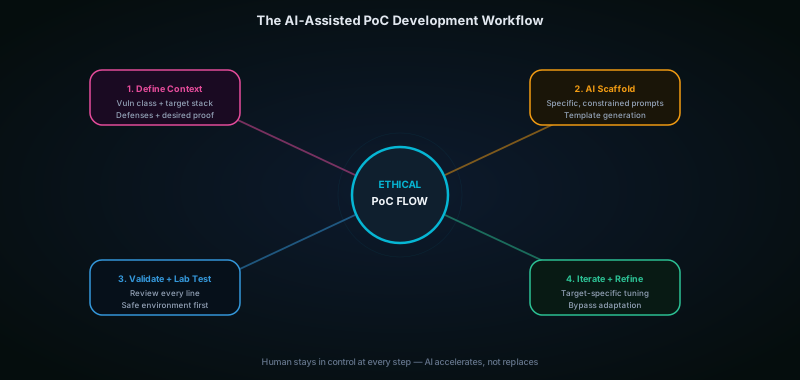
Step 1: Define the Vulnerability Context
Before opening any AI tool, document the engagement specifics:
- Vulnerability class: SQL injection, SSRF, deserialization, path traversal, etc.
- Target technology: Framework, language, version, middleware
- Access level: Unauthenticated, authenticated user, admin context
- Observed defenses: WAF rules, input filtering, output encoding, CSP headers
- Desired outcome: What does a successful PoC demonstrate? Data read, code execution, privilege escalation?
This context becomes the prompt foundation. Specificity determines output quality.
Step 2: Generate the Scaffold
Request a starting template from the AI. Not the final exploit. The skeleton.
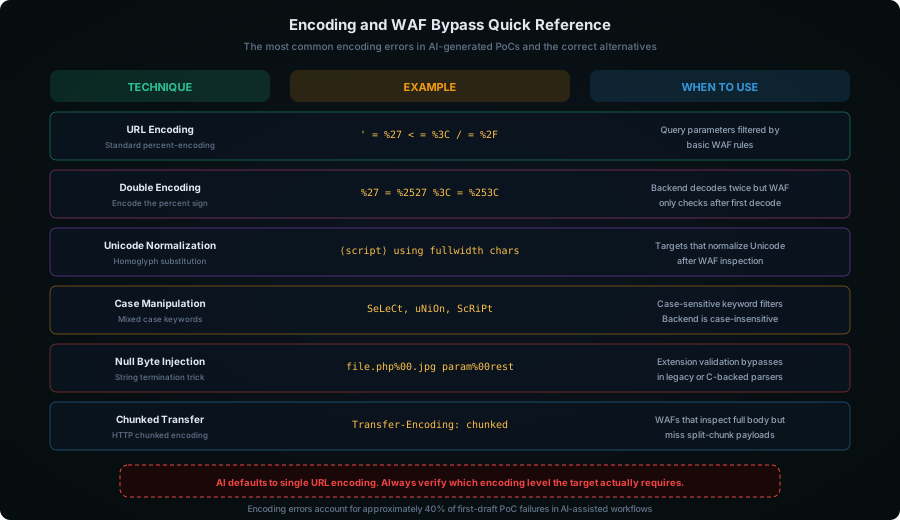
Effective scaffold prompts follow a pattern: specific vulnerability class + specific technology + specific constraints. Generic prompts produce generic code.
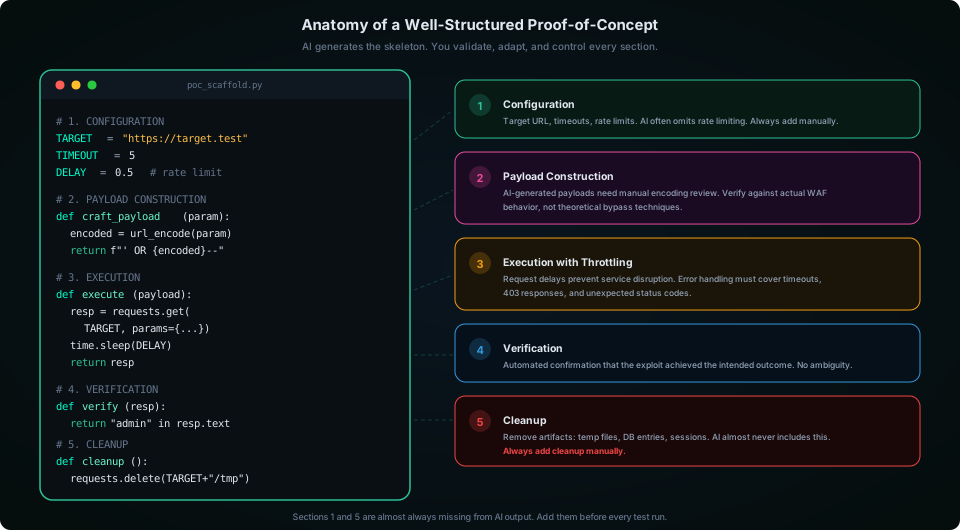
A blind SQL injection PoC against a PostgreSQL backend, for example, needs time-based delay detection and binary search logic. An SSRF PoC targeting a PDF renderer needs URL encoding for internal service access. The more constraints you provide, the closer the first draft lands.
Step 3: Review and Validate
This step separates professionals from reckless operators.
AI-generated code has predictable failure modes:
- Wrong target assumptions: Code generated for a default configuration that does not match the actual environment
- Incorrect encoding: Payload encoding that works in theory but breaks against the specific WAF or input filter
- Missing error handling: Code that crashes on unexpected responses instead of handling them gracefully
- Overly aggressive behavior: Rapid-fire requests that trigger rate limiting or cause service disruption
Read every line. Understand every function. Run the PoC against a local reproduction of the vulnerability before touching the target. Our platform provides isolated lab environments specifically designed for this validation step, where teams can safely test AI-generated code against realistic targets without risk.
Step 4: Iterate and Refine
The first output is almost never production-ready. The value is in iteration speed.
Run the scaffold against your lab. It fails because the encoding is wrong. Adjust the prompt to specify the exact WAF behavior you observed. It partially works but data extraction is too slow. Ask for parallelized requests with rate limiting built in.
Each iteration takes minutes instead of the 30 to 60 minutes required for manual research and coding. Over five or six rounds, convergence is significantly faster than a fully manual approach.
Prompt Patterns That Work
Certain prompt structures consistently produce better output. Each pattern addresses a different engagement scenario.
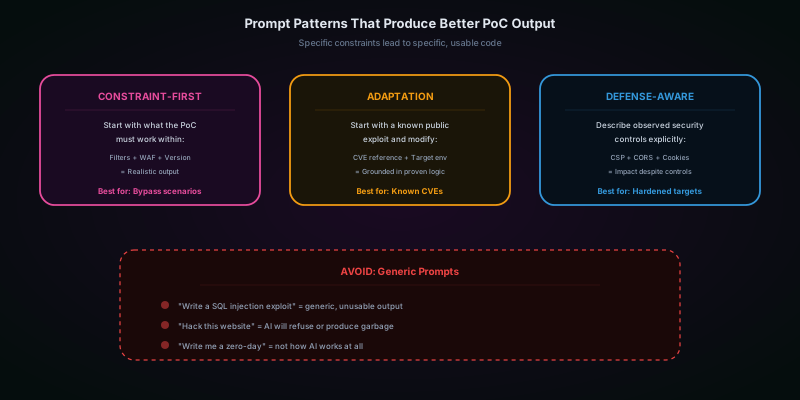
The Constraint-First Pattern
Start with what the PoC must work within, not what it should do.
"The target filters single quotes, blocks the UNION keyword, and uses a PostgreSQL 14 backend. Write a blind boolean-based SQL injection PoC that extracts the current database name character by character using conditional responses."
The constraints force the model to account for real-world defenses from the start.
The Adaptation Pattern
Start with a known public exploit and request specific modifications.
"Here is a public PoC for CVE-2024-XXXXX. Adapt it for an environment where the target runs behind a WAF and the vulnerable parameter is in a JSON body instead of a query string."
This leverages the model's strength at code transformation while grounding output in proven exploit logic.
The Defense-Aware Pattern
Explicitly describe the defensive measures observed.
"The application uses CSP with nonce-based script-src, HttpOnly cookies, and SameSite=Lax. Write an XSS PoC that demonstrates impact despite these controls. Focus on DOM manipulation or data exfiltration via CSS injection."
This produces PoCs that demonstrate real impact in hardened environments, not basic alert boxes.
Technical Deep Dive: Vulnerability-Specific Strategies
Different vulnerability classes require different AI prompting strategies. The following reference maps each class to the approach that yields the best results.
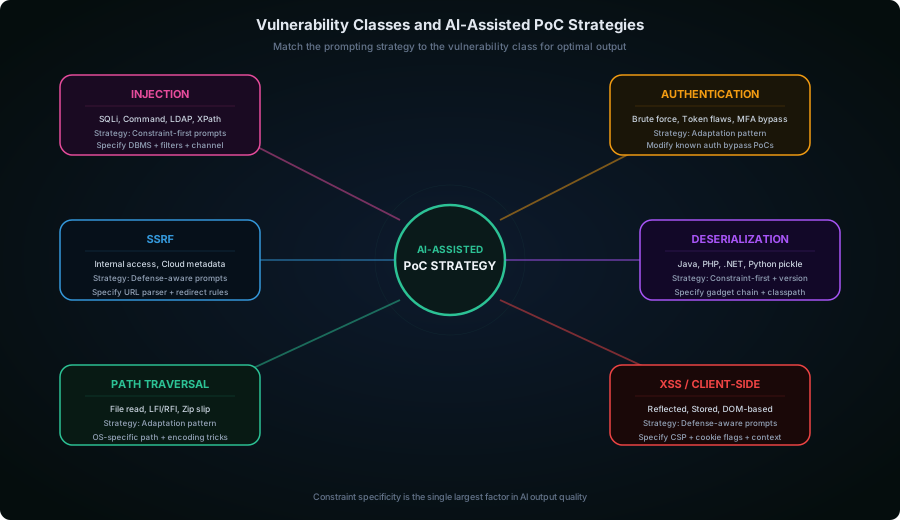
Injection Vulnerabilities
For SQL injection, provide the exact DBMS version, input filter behavior, and available output channels (in-band, blind boolean, blind time-based, out-of-band). Tools like SQLMap handle automated exploitation, but AI excels at generating custom payloads for edge cases where automated tools fail: nested encoding, second-order injection, and filter bypass chains.
For command injection, specify the shell interpreter (bash, PowerShell, cmd), character restrictions, and whether output is reflected. AI generates effective payload chains when given these constraints.
Server-Side Request Forgery
SSRF PoCs require knowledge of the internal network topology, the library handling URL parsing (different libraries parse URLs differently), and accessible internal services. Prompt the AI with the specific URL parser behavior, redirect-following rules, and DNS rebinding feasibility.
Deserialization
The most complex PoC category. Specify the serialization format (Java ObjectInputStream, PHP unserialize, .NET BinaryFormatter, Python pickle), available gadget chains, and classpath constraints. AI generates gadget chain construction code effectively when provided with the exact library versions present in the target.
Safety Practices
AI-assisted PoC development introduces specific risks that require specific mitigations.
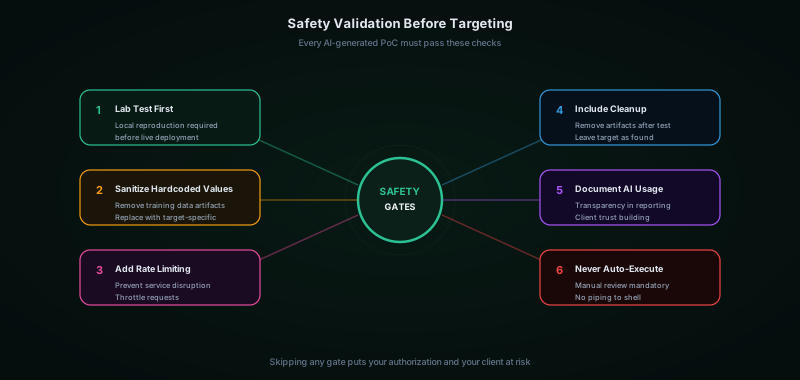
- Lab test everything. Maintain local reproductions of target vulnerabilities. OWASP Foundation provides open-source projects like Juice Shop and WebGoat for this purpose, and our platform offers guided lab environments that simulate real-world targets for safe validation.
- Sanitize AI output for hardcoded values. AI sometimes generates code with hardcoded IPs, paths, or credentials from training data. Review and replace with target-specific values.
- Add rate limiting to your PoCs. AI-generated code often lacks request throttling. Add delays between requests to avoid service disruption.
- Include cleanup routines. If the PoC creates artifacts (files, database entries, sessions), include cleanup code. Leave the target as you found it.
- Document the AI contribution. Note in your engagement records which parts of the PoC were AI-assisted. Transparency with clients builds trust.
- Never auto-execute AI output. Copy into your development environment, review, then execute manually. Never pipe AI output directly to a shell.
What AI Cannot Do
Keeping expectations grounded prevents wasted time and dangerous overconfidence.
AI cannot discover novel vulnerability classes. It recombines known techniques. If the objective is a zero-day, AI assists with PoC development after you find the bug, not before.
AI cannot guarantee exploit reliability. Real environments have race conditions, state dependencies, and timing constraints that AI-generated code rarely handles correctly on the first attempt.
AI cannot assess business impact. A working PoC is not the same as an accurate risk assessment. Regulatory implications, operational risk, and remediation priority require human judgment.
AI cannot make ethical decisions. Whether a particular test is within scope, whether the risk to production is acceptable, whether the client environment can handle the test. These are judgment calls that remain entirely yours.
Key Takeaways
AI-assisted PoC development is a genuine productivity gain for authorized security professionals. It compresses boilerplate coding time, accelerates iteration, and helps adapt known techniques to specific environments.
The methodology that delivers results treats AI as a drafting tool, not an authoring tool. The human provides vulnerability knowledge, environmental context, the ethical framework, and final validation. AI provides the first draft and fast iterations.
Used correctly, teams spend less time writing code and more time uncovering the next vulnerability. That is the real value: faster proof that leads to faster remediation.
End of Article
Continue Reading
 8 min read
artificial intelligencepenetration testing+3
Can AI Replace Penetration Testers? A Reality Check
Separating hype from reality. What AI can and cannot do in penetration testing, and why the human pentester is not going anywhere.
Security Research Team·2026-03-03
 8 min read
ssrfweb application security+3
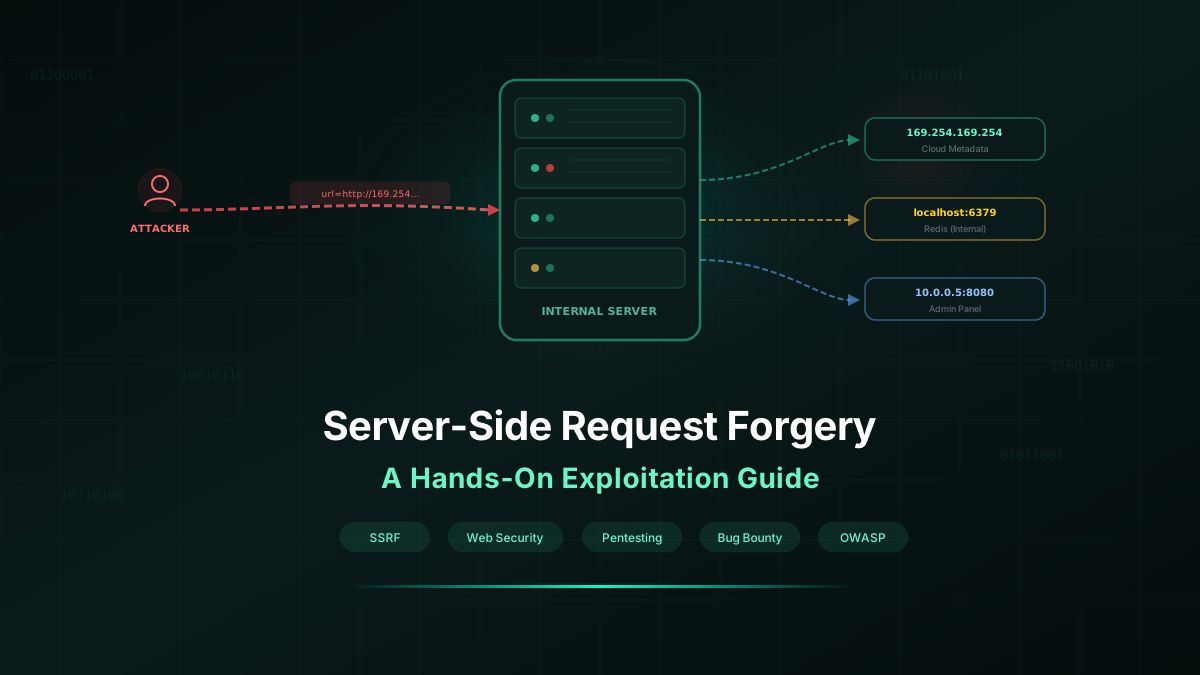
Server-Side Request Forgery (SSRF): A Hands-On Exploitation Guide
A practical, step-by-step walkthrough of SSRF — from finding vulnerable endpoints to exploiting cloud metadata, bypassing filters, and chaining SSRF to full compromise.
Security Research Team·2026-03-07
 8 min read
bug bountyethical hacking training+3
Beginner Guide to Bug Bounty: Find Your First Vulnerability in 7 Days
A realistic 7-day roadmap to finding your first web vulnerability in a bug bounty program, covering tools, methodology, and the mindset that gets results.
Security Research Team·2026-02-16